
Roof Ridge Repair: Signs, Methods, Costs and Safety
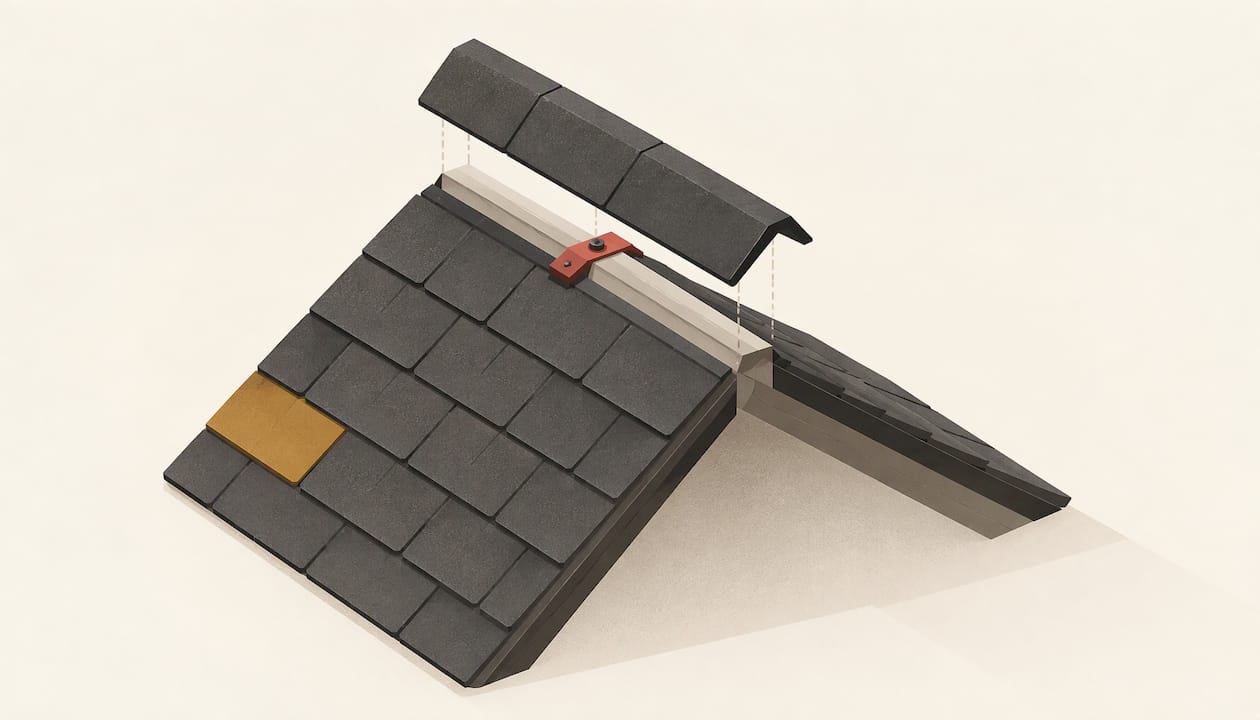
A failing ridge is one of the most common reasons a sound roof starts to leak, and one of the most dangerous places to fix it yourself. The ridge is the top line of the roof, where two slopes meet. Repairing it properly means removing failed mortar or damaged tiles, re-bedding or re-fixing the ridge so it is held mechanically, and doing all of it at height with fall protection. That is a job for a competent roofer, and a good one will tell you exactly what they found, what they are replacing and why. Below you will find the warning signs, the two main repair methods, what the work costs in the UK and what safe working looks like.
TL;DR
- Ridge tiles cap the join between two roof slopes. When the mortar cracks or a tile slips, water and wind get into the roof at its highest point.
- A proper repair removes the failed mortar, then re-beds the tiles with a mechanical fix, or converts the ridge to a dry-fix system.
- Which? reports £80 to £300 to replace a single ridge tile, excluding VAT, with longer runs costing more.
- Roof work at height needs edge protection and safe access. It is not a job to attempt from a ladder with a bucket of mortar.
- A loose or fallen ridge tile is worth a prompt inspection, before the next storm turns a small repair into an interior leak.
Table of Contents
- What the ridge does and why it fails
- Signs your ridge needs attention
- What happens if a ridge tile comes loose or falls off
- Mortar ridge or dry ridge: the two repair routes
- How much ridge repair costs in the UK
- Why ridge repair is roof work, not a weekend job
- Homeowners and property managers: what to ask for
- Fixing your ridge with Yellowstone
- Our view on ridges
- FAQ
- Sources
What the ridge does and why it fails
Ridge tiles sit along the apex of the roof and cap the junction of two slopes, protecting that line from the weather. On a simple gable roof there is one ridge. On a complex roof, with extensions, dormers or a hipped shape, the ridge can run in several lines, and every one of them is a potential entry point for water.
Traditionally ridge tiles are bedded in mortar. Mortar is hard and rigid, while a roof moves: it expands and contracts with temperature, flexes in wind and settles over the years. Manufacturer guidance describes mortar as prone to bond failure because of differential roof movement, which is why modern guidance calls for mortar bedding to be backed up by a mechanical fix.
In practice that means a ridge laid decades ago with mortar alone is likely to crack sooner or later. Frost gets into the cracks, the mortar crumbles and a tile that was once solid starts to rock.
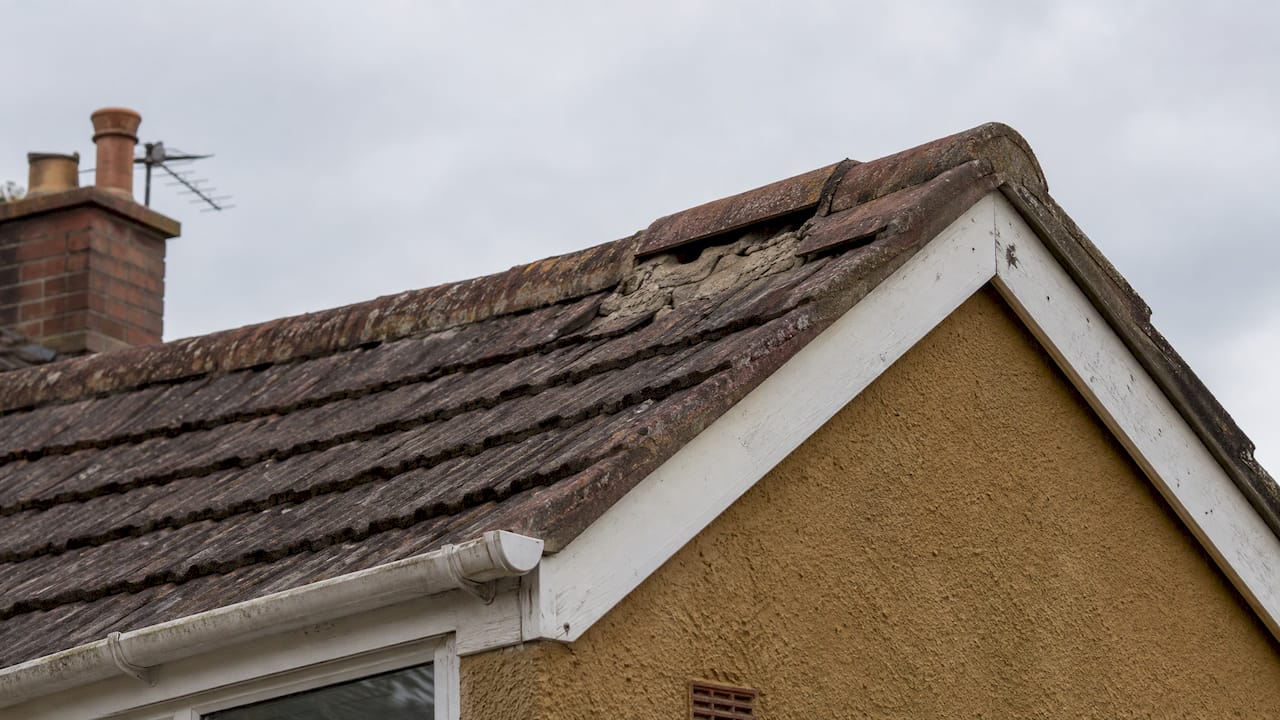
Signs your ridge needs attention
You can check a lot from the ground, in daylight, with a pair of binoculars or the zoom on a phone camera. You do not need to climb anything.
- Cracked or crumbling mortar along the ridge line, sometimes with bits of it on the ground, in the gutter or on a flat roof below.
- Tiles out of line. A ridge tile that sits at an angle, or a visible gap between neighbouring tiles, has lost its bedding.
- Missing tiles. A dark gap along the ridge where a tile used to be.
- Mortar-coloured grit in the gutters, which usually means the mortar is breaking down above.
- Stains on the loft ceiling or damp patches near the top of upstairs walls. Water entering at the ridge often shows up inside before anything looks wrong outside.
- A sagging ridge line. If the ridge itself dips rather than just the tiles, the cause may be structural, such as timber under strain, and needs a proper inspection rather than a cosmetic fix.
Sagging is the one to treat most seriously. A dip in the roofline can come from slipped bedding, but it can equally point to a problem in the timbers beneath, so a roofer should look at it from inside the loft as well as from outside.
What happens if a ridge tile comes loose or falls off
A missing or loose ridge tile exposes the top of the roof. Rain can then reach the felt and timbers below the ridge, and wind can lift neighbouring tiles. A loose tile is also a falling hazard for anyone on the path or drive below, so keep people away from that side of the house until it is dealt with.
Do not try to retrieve or push it back yourself. If it is a safety risk, a roofer can make the area safe and secure the roof until a full repair can be carried out. If the damage came with a storm, building insurance often responds to storm damage, but policies differ. Some insurers set a minimum wind speed, and gradual wear and tear is usually excluded. Read your policy, photograph the damage from a safe place on the ground and report it promptly.
If water is already coming in, our emergency roof repair service covers Malmesbury and Wiltshire.
Mortar ridge or dry ridge: the two repair routes
There are two ways to put a ridge back, and a good roofer will explain which suits your roof.
Re-bedding and repointing a mortar ridge
This is the traditional repair and suits a ridge in generally good condition with localised failure. The work involves:
- Setting up safe access and edge protection.
- Lifting the affected ridge tiles and removing the failed mortar, so new mortar bonds to a clean base rather than to crumbling material.
- Checking the tiles for cracks and replacing any that are damaged.
- Re-bedding the tiles on fresh mortar. Manufacturer guidance gives a typical roof mortar as 3 parts sand to 1 of cement with plasticiser, with sharp sand making up at least a third of the sand in a blended mix.
- Adding a mechanical fix, since the same guidance says mortar bedding should be accompanied by one under BS 5534, the British Standard for roof slating and tiling.
- Cleaning down and clearing debris from the roof and gutters.
The mix and the mechanical fix are where cheap repairs go wrong. A thin smear of mortar over cracked old bedding looks tidy for a season and then lets go. That is why the preparation, not the mortar, is most of the job.
Switching to a dry ridge system
Dry ridge fixes the tiles without sand and cement. Manufacturer guidance says ridge tiles were traditionally bedded in mortar, but dry-fix methods are now specified as standard in most cases. These systems use adhesives and mechanical fixings to attach the tiles to a ridge batten, include built-in ventilation and are designed to comply with BS 8612:2018, the standard for dry-fixed ridge, hip and verge systems.
One installation guide describes the sequence: a ridge batten and roll go centrally over the apex, the tile edges are sealed, the tiles are joined with seals and fixed with screws, washers and clamping plates. The same manufacturer’s advice is that dry ridge is a low-maintenance option because there is no mortar to crack, and that ventilated systems let moist air leave the roof void.
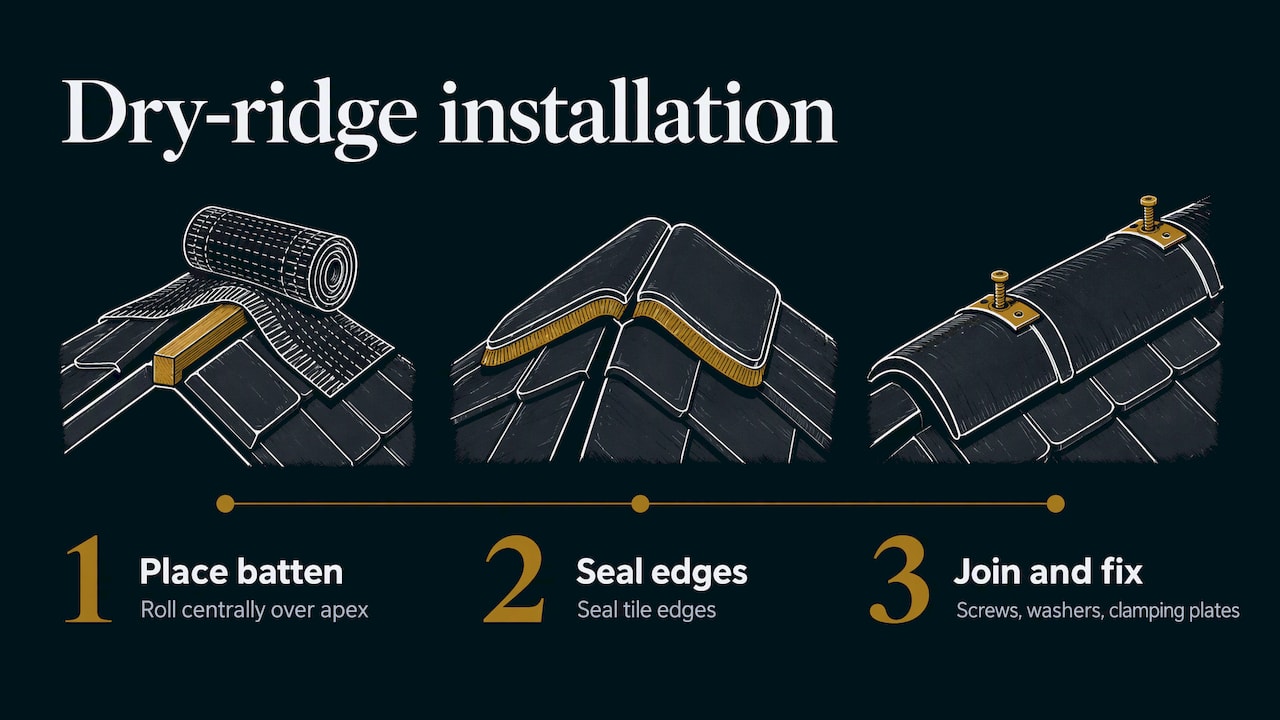
The point worth taking from this is that dry ridge is a complete system, not a substitute for mortar. The batten, the sealing, the joins and the end detailing all have to be right, which is another reason to have it fitted by someone who works with the system regularly.
Which should you choose?
| Situation | Usual route |
|---|---|
| A few cracked joints, tiles otherwise sound | Repointing or re-bedding a section |
| Several loose tiles along a long run | Full re-bed with mechanical fix, or dry ridge |
| Repeat failures of mortar on the same roof | Dry ridge, since there is no mortar to crack |
| Damp, condensation or musty smell in the loft | Dry ridge with ventilation, assessed with the loft ventilation |
| Sagging ridge line | Inspect the structure first, then decide |
Your roofer should recommend the route after looking at the whole ridge, not only the tile that caught your eye. If the roof is near the end of its life, a ridge repair may be the moment to discuss replacing the roof covering instead. Our new roofs page explains that work.
How much ridge repair costs in the UK
Prices vary with the length of ridge, access, the type of tile and whether scaffolding is needed. Which? surveyed 11 Trusted Traders in November 2025 and reports £80 to £300 to replace a single ridge tile, including labour and materials but excluding VAT. It notes costs are likely to be higher in London and the South East, and that price also depends on where you live, the age and condition of the property, how long the job takes, roof access, the tile or material, and whether scaffolding is needed.
Here is what that means in practice:
- One or two tiles: a small job, but the call-out and access still count. Access is often the biggest part of the bill.
- A full ridge: a longer run costs more, and the choice between mortar and dry fix changes the total. Ask for the quote to state which method is used.
- Scaffolding: if the roof cannot be reached safely from a ladder, scaffolding is a legitimate cost, and it is what keeps the work within the law.
- Repeat visits: fixing one tile at a time every winter usually costs more than one thorough repair.
A good quote should say how much ridge is being dealt with, the method, what happens to cracked tiles and whether access equipment is included. We give free written estimates, so you can compare like with like. For wider context on repair pricing and what drives it, see our guides to residential roof repair and roof tile replacement.
If the roof has a chimney, the stack and its flashing sit close to the ridge and are often repaired at the same visit, so it helps to look at chimney repointing at the same time.
Why ridge repair is roof work, not a weekend job
The ridge is the highest point of the roof, and the law treats roof work seriously. The Health and Safety Executive says all roof work must be planned and organised safely, workers must be trained and competent, and a method statement is a common way to communicate the precautions. For sloping roofs, scaffolding and edge protection are needed to prevent falls. Properly secured ladders and roof ladders may be used for short-duration tasks.
HSE guidance on working on roofs adds specifics: edge protection with a main guard rail at least 950 mm above the edge, a toe board and no gap above 470 mm, secure access, no work in icy, rainy or windy conditions, and no walking directly on tiles or slates.
For a homeowner, that means three things:
- Do not climb onto the roof to inspect or fix the ridge. Look from the ground.
- Ask any roofer how they will access the ridge and protect the edge. A clear answer is a good sign.
- For property managers, the same planning duties apply to contractors working on your building, so ask for a method statement before work starts.
Safe working also goes beyond the roof surface. If you are looking at the roof’s moisture and ventilation as a whole, such as damp in the loft, roofing repairs and upgrades can involve surveys of damp, timber and ventilation alongside the ridge itself.
Homeowners and property managers: what to ask for
Whether it is a semi in Swindon or a block of units with several roof lines, the same questions apply:
- Which method is proposed, mortar with a mechanical fix or dry ridge, and why?
- How many metres of ridge, and are cracked tiles being replaced?
- How will the roof be accessed and protected?
- Is the work guaranteed in writing?
- Are the roof’s other weak points, such as hips, valleys, verges and flashings, being checked while the crew is already up there?
For larger buildings, our commercial roof repairs guide sets out how we approach maintenance for property managers.
Fixing your ridge with Yellowstone
Yellowstone Roofing and Property Contractors carries out roof repairs, new roofs and maintenance for residential and commercial clients. Our work is fully guaranteed and covered by extensive warranties, and we manage the project from start to finish so you are not chasing several trades. Estimates are free and in writing.

If you have spotted cracked mortar, a slipped tile or a stain in the loft, see our roof repairs page for Malmesbury, Swindon and Cirencester, or get in touch through our website for a free written estimate. In Wales we also cover Newport, and in Bath, Bath.
Our view on ridges
We see the ridge as the part of the roof that deserves the most care, because everything below it depends on it staying sealed. A ridge repair is small in square metres and large in consequences.
Our approach is to treat the repair as part of the whole roof. We look at the tiles either side, the state of the bedding and the loft below, so the work solves the cause rather than the symptom. Where a mortar ridge has failed more than once, we think a mechanically fixed or dry-fix ridge is the sensible conversation to have.
And because it is work at height, we plan it as such: safe access, edge protection and a tidy site. Our work is fully guaranteed, and we would rather you ask us about the ridge in the first dry week than call us during the first storm.
Trey
FAQ
How can I repair my ridge tiles?
A proper repair removes the failed mortar, re-beds or replaces the tiles and adds a mechanical fix, or converts the ridge to a dry-fix system. Because this is work at height with fall risks, it should be done by a roofer with scaffolding or other suitable access. Our team can quote for either method.
How much does it cost to repair ridge capping?
Which? gives £80 to £300 to replace a single ridge tile, excluding VAT, with higher prices likely in London and the South East. Longer runs, scaffolding and the choice of mortar or dry fix change the total, so a written estimate for your roof is the reliable figure.
What happens if ridge tiles come off?
The top of the roof is exposed, so rain can reach the felt and timbers and wind can lift nearby tiles. A loose tile can also fall, so keep people clear of that area. Arrange an inspection promptly, and if a storm caused it, photograph the damage from the ground and contact your insurer.
How do I fix a sagging roof ridge?
A sagging ridge can be a bedding problem, but it can also point to strain in the timbers below, so it needs inspecting from inside the loft and outside. The fix depends on the cause, from re-bedding the tiles to structural work. Ask a roofer to look at it rather than guessing from below.
Sources
- What are ridge tiles (Marley)
- Roofing Sitework Guide, October 2024 (Marley)
- Installation Guide for Ridge (Klober)
- How to Fit a Dry Ridge Kit (Klober)
- How much do roof repairs cost? (Which?)
- Roof work (HSE)
- Working on roofs, INDG284 (HSE)
- What to do if your roof tiles fall off (Lemonade)